Showing posts with label Vancouver. Show all posts

Tuesday, May 28, 2013

1921 Gardening on a City Lot in BC: 35 cents per day or $127.75 per year

Life is so complicated now, because of the internet. It's all about security, including Tomatoes.
Biosecurity Guidelines for Post - harvest Greenhouse Tomatoes: Prevention of Post - harvest and Storage Rot  - March 27, 2013


Link to Ron Finley Ted Talk Plants vegetables garden south central LA

Updated 2024-03-05  via the WayBackMachine 

https://web.archive.org/web/20130527105459/https://www.ted.com/talks/ron_finley_a_guerilla_gardener_in_south_central_la.html

 
In earlier days, like the 1920's, there were more important objectives.... SURVIVAL of the fittest and we're not just talking about Tomatoes alone.

The City of Vancouver was incorporated on April 6, 1886, the same year that the first transcontinental train arrived.   There was no Costco or Safeways, maybe a "corner store" here and there, but if you had land, and there was lot of that around per capita, for the taking, then you could have your own source without depending upon California and a link via a Skagit River crossing.

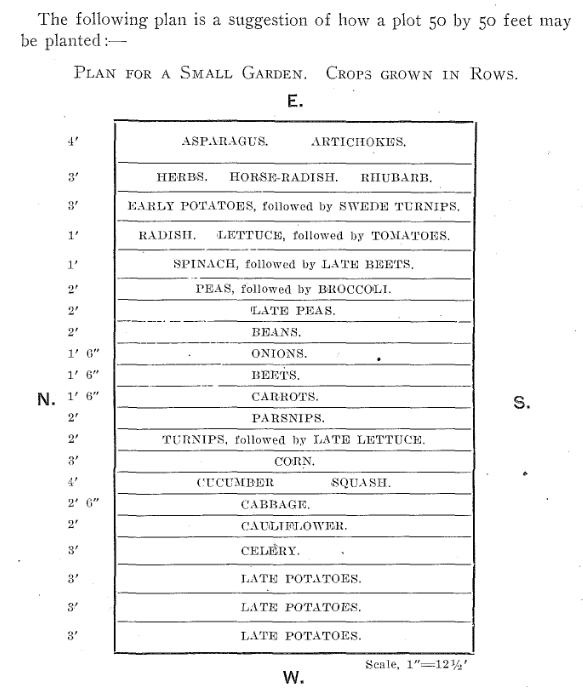
All you needed was a 50' X 50' plot of land dedicated to your garden... Another 50' X 100' for the house and stable.

Gardening on a City Lot in BC


January and February, kale, parsnips, leeks, lettuce, and parsley;
March,spinach and broccoli;
April,  radish, onions, rhubarb, and broccoli;
May, asparagus and peas;
June, early cabbage, carrots, and beets;
July, early potatoes, parsnips, and beans;
August, tomatoes, cauliflower, onions, cucumbers, and summer squash;
September, cabbage, salsify, and herbs;
October, celery, brussels sprouts, leeks, and winter squash;
November, fall lettuce and early spinach;
December, same as for January and February.

Besides the fresh vegetables which may be had through the winter months, the gardener can have a large variety stored, including potatoes, beets, carrots, onions, celery, squash, and turnips.

~~~~~~~~~~~~~~~~~

In 1921 the BC Government pegged the costs of food shopping at Thirty-Five cents a day  One Hundred Twenty Seven and 75/100 Dollars per year.

2013, taking into account Inflation.... that works out to  $1,536.76 ..... per year.  Does that sound about right?

Or does it mean that the Bank of Canada Inflation bean counters software is out of whack, has been out of whack for a long time.

~~~~~~~~~~~~~

The early settlers but later than 1886, following the First World War, were encouraged to come to Canada, to British Columbia where they had to clear the trees, the stumps, plow the land, seed the fields, tend the fields, harvest the field, and have the resources, FOOD to last until the next year ..... like these Links to previous Posts here at the BBC.

Soldiers and RaspberriesStalwart PeasantOats, Wheat and Barley Grows. Firsts for Women, Taxes and Tolls, Pigeon Phones, 125 year old VancouverTom Carter Gallery, Len Norris, Warner Loat, Trutch

Were City Lots dimensions determined by the need of its residents to fend for themselves, wholly dependent upon the land?   Were the backyard buildings still housing stables for horses, soon to be replaced by cars... which didn't create manure for the garden?  Up until 1950's Dairyland delivered their milk by HORSE... the manure was fantastic.... so Mr. D (our neighbour) used to say.... D is for Davis....

Today's residential Front Yards, now they could be used for a vegetable garden..... 26' setback X 50' wide or 33' wide... as long as there are not Horse Chestnut Trees growing on the front street ....  would the southern facing street front yards have more daylight than the their Northern facing front yards .... all depends on the size of the house, not by today's standards, but pre 1921.... is there an inflation counter for buildings...
A greenhouse would help....

Tuesday, December 27, 2011

My contribution to creating an IPP in every home on the North Shore of Vancouver.

Date: December 23, 2011

Location: Riverway Golf Course (owned and operated by Municipality of Burnaby)

Reason:  Company Year end Dinner


Why not talk shop, why not brainstorm, on the very last day of the year before we meet again for the daily grind on January 2nd, 2012.  Christy will be doing the same thing, Thinking, and being paid handsomely for her efforts.  Whereas we six, will be paid on our own dime.

I put it to the plumber in the crowd "What's the water pressure going into a house?"  "Depends" he said "on where you live."   "North Shore"   "80 lbs."

Google Search Criteria    Water pressure to houses on the north shore of burrard inlet
Its one thing to ask a simple question like water pressure going into a house without realizing where OUR water comes from in the first place.  "A TAP".... good guess, try again.   "The north shore?"  Partially right.  There's a bit of geography involved here, like why is Stanley Park's Prospect Point still there, after an IceAge has flowed off from a continent to finally settle a small portion of itself into English Bay and Georgia Strait....

Why oh Why is Prospect Point still there, after the Ice Age?   Why doesn't every harbour have a Prospect Point?

The year is 1889, the date is March 26:  The data that follows was prepared by Researcher: Roy J.V. Pallant
Surveys for the tunnel were simplified by the fact that the
centre of each shaft was visible from the other. - Page 9
· Ground level at the south shaft in Stanley Park some
distance back from the foreshore was twenty-three feet
above sea-level and conditions for open excavation were
most favourable. For the first sixty-five feet, the shaft was
in clay hardpan, the balance of the 400 feet in sandstone.
The shaft was timbered to a depth of twenty-five feet, after
which a concrete lining was used. After excavation of the
shaft and after the tunnel was driven several hundred feet,
a pump to lift 200 gallons per minute was installed and a
weir built which in fact sufficed until the tunnel was
completed.
Pearson Scott Foreman


A plug of concrete, twelve feet thick, was placed at the bottom of the Caisson, to stop it from moving and sealing it to the bedrock.  The miners then drilled a hole through the concrete, and another 400 feet down through the bedrock

With the site fixed by the point where underlying sandstone
was at the least depth below sea level sinking of the north
shaft presented problems. To begin with, several feet of
water at average tides covered the location. That
necessitated a caisson within which sinking would be done.

 Driving the tunnel was quite as routine as an ordinary
mining tunnel, the only essential difference being that the
bore was located 400 feet below sea level. While miners
pegged away with drill and jackhammer, great ocean liners
and noisy tugs steamed back and forth through the
Narrows entrance of one of the world's busiest harbours.
Three shifts of eight hours were worked continuously and
every round of holes fired marked an advance of seven or
eight feet. Use of extra powder broke up the muck so that it
was easily handled by hand labour loading small cars and a
locomotive hauling them to the south shaft where the spoil
was raised.  (Page 11)
 From the earliest days of the development of Vancouver
and district water supply, the submerged mains, now
superseded
, have been considered a rather precarious link.
Years ago the Vancouver City Council instructed the later
Col. T.H. Tracy, first city engineer, to report on the
feasibility of a tunnel. Proposals were even put forward for
a bridge to carry the supply mains. (Page 13 of 14)

Homeowner operated  IPP suggestion?    Why not hook up a micro water driven hydro generator to the incoming water line to every household?  Why not have larger users of water eg. Hospitals and Rec Centres, use the incoming pressure of water to supplement their electricity needs?