Showing posts with label Trutch. Show all posts

Tuesday, June 10, 2014

"Evidence and Proceedings" of Kitsilano Indian Reserve (Musqueam) 1915: The Case of the missing $300,000

A Centenary is a special event, right, even for the Musqueam First Nation people who were paid $300,000 in 1913 for land that the south side of Burrard Bridge squats upon. The First Nation people could have waited, until now, to receive the windfall of $6,260,000, except that it was the "Indian Agent" that guesstimated the value of the 1913 land as being worth $1 Million to  $1.5 Million to  $2 Million.

Today that land is in the high millions, if not a billions.


Clerk of the House
Papers, 1916
Special committee to enquire into Kitsilano Indian Reserve.
Monday, 27th of March 1916
Page 2 of 275

Present:
     Ernest Miller, MLA (Chairman)
 L. W. Shatford, MLA (Secretary)
Parker Williams, MLA
   Thomas Clifford, MLA

L.J. Seymour was sworn as stenographer.

First Witness: William Allison, Auditor-General

$300,000
Page 9 of 275


Page 17 of 275
Page 24 of 275

Mapping timeline tool for Kitsilano Indian Reserve:


************************
Earlier Post


 ..... Sir James Douglas' reserve policy generally allowed Indians to select as much land as they wanted.  In 1861 Douglas directed the Chief Commissioner of Lands and Works, who had responsibility for laying out these early reserves, to "take measures to .... for marking out distinctly, the Indian Reserves throughout the Colony".  He added that "the extent that the Indian Reserves to be defined" was to be "as they may be pointed out by the native themselves".

This policy was dramatically reversed in 1864 - 1865 by Joseph Trutch.  As head of the colonial Department of Lands and Works, Trutch initiated a policy of reduction of the Douglas' reserves, of reluctance to allot additional reserves, and of non-recognition of the Indian's aboriginal claim  (native title).  .....
The First Nations People have demanded that the Vancouver street name of "Trutch" be Trashed, 

Reason: Racist

Tuesday, May 28, 2013

1921 Gardening on a City Lot in BC: 35 cents per day or $127.75 per year

Life is so complicated now, because of the internet. It's all about security, including Tomatoes.
Biosecurity Guidelines for Post - harvest Greenhouse Tomatoes: Prevention of Post - harvest and Storage Rot  - March 27, 2013


Link to Ron Finley Ted Talk Plants vegetables garden south central LA

Updated 2024-03-05  via the WayBackMachine 

https://web.archive.org/web/20130527105459/https://www.ted.com/talks/ron_finley_a_guerilla_gardener_in_south_central_la.html

 
In earlier days, like the 1920's, there were more important objectives.... SURVIVAL of the fittest and we're not just talking about Tomatoes alone.

The City of Vancouver was incorporated on April 6, 1886, the same year that the first transcontinental train arrived.   There was no Costco or Safeways, maybe a "corner store" here and there, but if you had land, and there was lot of that around per capita, for the taking, then you could have your own source without depending upon California and a link via a Skagit River crossing.

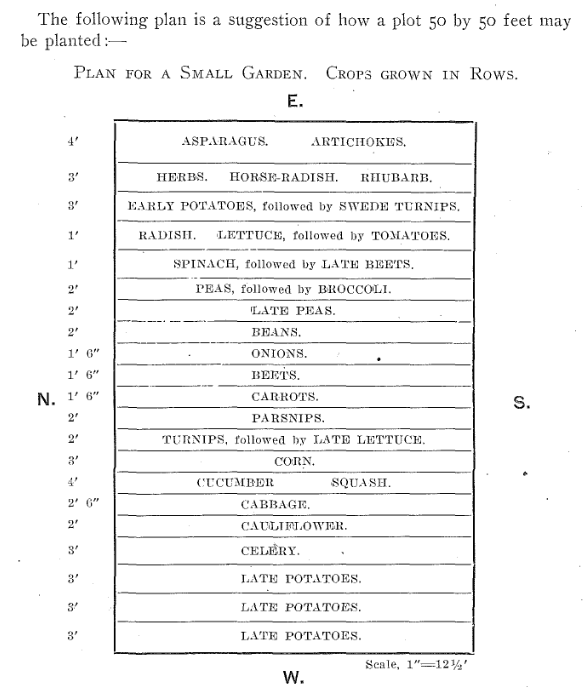
All you needed was a 50' X 50' plot of land dedicated to your garden... Another 50' X 100' for the house and stable.

Gardening on a City Lot in BC


January and February, kale, parsnips, leeks, lettuce, and parsley;
March,spinach and broccoli;
April,  radish, onions, rhubarb, and broccoli;
May, asparagus and peas;
June, early cabbage, carrots, and beets;
July, early potatoes, parsnips, and beans;
August, tomatoes, cauliflower, onions, cucumbers, and summer squash;
September, cabbage, salsify, and herbs;
October, celery, brussels sprouts, leeks, and winter squash;
November, fall lettuce and early spinach;
December, same as for January and February.

Besides the fresh vegetables which may be had through the winter months, the gardener can have a large variety stored, including potatoes, beets, carrots, onions, celery, squash, and turnips.

~~~~~~~~~~~~~~~~~

In 1921 the BC Government pegged the costs of food shopping at Thirty-Five cents a day  One Hundred Twenty Seven and 75/100 Dollars per year.

2013, taking into account Inflation.... that works out to  $1,536.76 ..... per year.  Does that sound about right?

Or does it mean that the Bank of Canada Inflation bean counters software is out of whack, has been out of whack for a long time.

~~~~~~~~~~~~~

The early settlers but later than 1886, following the First World War, were encouraged to come to Canada, to British Columbia where they had to clear the trees, the stumps, plow the land, seed the fields, tend the fields, harvest the field, and have the resources, FOOD to last until the next year ..... like these Links to previous Posts here at the BBC.

Soldiers and Raspberries,  Stalwart Peasant,  Oats, Wheat and Barley Grows. Firsts for Women, Taxes and Tolls, Pigeon Phones, 125 year old Vancouver,  Tom Carter Gallery, Len Norris, Warner Loat, Trutch

Were City Lots dimensions determined by the need of its residents to fend for themselves, wholly dependent upon the land?   Were the backyard buildings still housing stables for horses, soon to be replaced by cars... which didn't create manure for the garden?  Up until 1950's Dairyland delivered their milk by HORSE... the manure was fantastic.... so Mr. D (our neighbour) used to say.... D is for Davis....

Today's residential Front Yards, now they could be used for a vegetable garden..... 26' setback X 50' wide or 33' wide... as long as there are not Horse Chestnut Trees growing on the front street ....  would the southern facing street front yards have more daylight than the their Northern facing front yards .... all depends on the size of the house, not by today's standards, but pre 1921.... is there an inflation counter for buildings...

A greenhouse would help....

Tuesday, April 2, 2013

"Trutch" we never Trusted. How about Truce, Christy?

 What's in a name eh......    Names of landmarks have been changed across British Columbia like Chinaman Lake to Chunamun Lake and Boss Lake (Uranium Fame $30 million worth) to Bosk Lake.

A BC Government Website likes to hang onto the old names database, by listing off their "Alias", like it was a crime, a fraud and to a large degree, they were.   If Grandpa called the best fishing hole in British Columbia "Rum Cache", don't look for it on the map, the name is now Cicuta Lake, south-west of Vanderhoof, well before you reach the Nechako Reservoir.


Christy Clark is the MLA for Vancouver-Point Grey, although you'd never know it (RossK...... ). Within the next 33 days, before she leaves her three Offices as Premier of British Columbia, perhaps she would consider putting pen to paper and ask Vancouver's Mayor Gregor Robertson to delete the street called Trutch.    Doyle Street?

And please Christy, no more of your pandering towards specific groupings for votes with a Street name.


92% of 100% Reserve land was put aside for the 1% like Trutch, by Trutch, for Trutch!

Page 8 of  279

Land policy under Colonial B.C. 1850 - 1871

The first Indian (First Nation Land) Reserves were created in this period.  These reserves were located on southern Vancouver Island, the Fraser Valley, the Fraser Canyon, Kamloops, the Nicola Valley, the Okanagan,  and the Shuswap Lake areas.  Most of these were set up by Sir James Douglas in the early 1860's.

Douglas' reserve policy generally allowed Indians to select as much land as they wanted.  In 1861 Douglas directed the Chief Commissioner of Lands and Works, who had responsibility for laying out these early reserves, to "take measures to .... for marking out distinctly, the Indian Reserves throughout the Colony".  He added that "the extent that the Indian Reserves to be defined" was to be "as they may be pointed out by the native themselves".

This policy was dramatically reversed in 1864 - 1865 by Joseph Trutch.  As head of the colonial Department of Lands and Works, Trutch initiated a policy of reduction of the Douglas' reserves, of reluctance to allot additional reserves, and of non-recognition of the Indian's aboriginal claim  (native title).

An example of Trutch's policy of reduction can be seen along the Thompson River.  The Indians of Kamloops, Neskainlith and Shuswap Lake originally held a reserve along the north bank of the South Thompson River from Kamloops to Shuswap Lake.  This included Little Shuswap Lake and areas around Adams Lake.  In 1866 these reserves were "adjusted" by Trutch by reducing them to approximately their present size.

This policy was extended to the Fraser Valley in 1867.  It is difficult to get precise information on the location and size of the present reserves in the Fraser Valley are only remnants of the original reserves.

To learn more about these early "cut-offs" and other land grievances in the 1850 -1871 period, see the article, "Joseph Trutch and Indian Land Policy"  in B.C. Studies  (1971 - 72) by Robin Fisher.

Snip


CBC Lede: Sticker campaign targets Trutch Street signs

..... He (Trutch) also made sure Indian reserves were small, quickly overturning the generous and inclusive decisions of his colonial predecessor, Governor James Douglas.

"He reduced the reserves that Douglas had allowed for by 92% and changed the laws so that a Sto:lo family could only occupy about 10 acres of land," says Kluckner.
Trutch went on to be the first lieutenant-governor of B.C. in 1871, when the province decided to join Confederation.

"His policies and the policies of the government of the time were perfectly in keeping with serving the needs of the British government,” says documentary filmmaker Vince Hemingson.  .......