Showing posts with label 1921. Show all posts

Tuesday, May 28, 2013

1921 Gardening on a City Lot in BC: 35 cents per day or $127.75 per year

Life is so complicated now, because of the internet. It's all about security, including Tomatoes.
Biosecurity Guidelines for Post - harvest Greenhouse Tomatoes: Prevention of Post - harvest and Storage Rot  - March 27, 2013


Link to Ron Finley Ted Talk Plants vegetables garden south central LA

Updated 2024-03-05  via the WayBackMachine 

https://web.archive.org/web/20130527105459/https://www.ted.com/talks/ron_finley_a_guerilla_gardener_in_south_central_la.html

 
In earlier days, like the 1920's, there were more important objectives.... SURVIVAL of the fittest and we're not just talking about Tomatoes alone.

The City of Vancouver was incorporated on April 6, 1886, the same year that the first transcontinental train arrived.   There was no Costco or Safeways, maybe a "corner store" here and there, but if you had land, and there was lot of that around per capita, for the taking, then you could have your own source without depending upon California and a link via a Skagit River crossing.

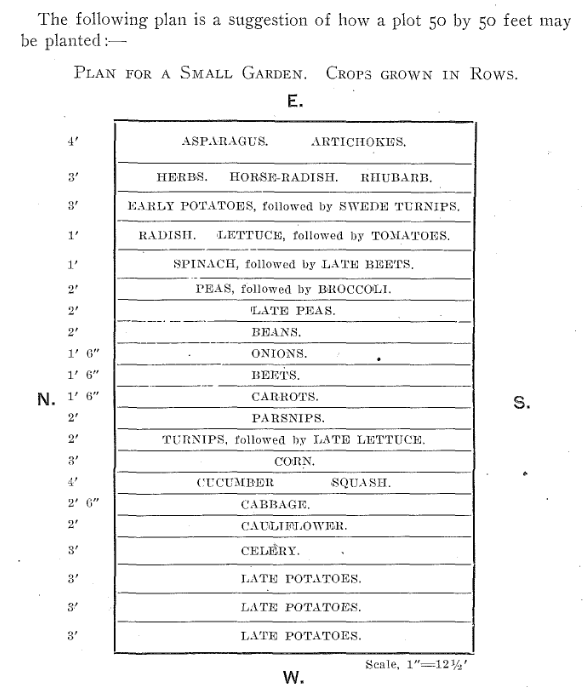
All you needed was a 50' X 50' plot of land dedicated to your garden... Another 50' X 100' for the house and stable.

Gardening on a City Lot in BC


January and February, kale, parsnips, leeks, lettuce, and parsley;
March,spinach and broccoli;
April,  radish, onions, rhubarb, and broccoli;
May, asparagus and peas;
June, early cabbage, carrots, and beets;
July, early potatoes, parsnips, and beans;
August, tomatoes, cauliflower, onions, cucumbers, and summer squash;
September, cabbage, salsify, and herbs;
October, celery, brussels sprouts, leeks, and winter squash;
November, fall lettuce and early spinach;
December, same as for January and February.

Besides the fresh vegetables which may be had through the winter months, the gardener can have a large variety stored, including potatoes, beets, carrots, onions, celery, squash, and turnips.

~~~~~~~~~~~~~~~~~

In 1921 the BC Government pegged the costs of food shopping at Thirty-Five cents a day  One Hundred Twenty Seven and 75/100 Dollars per year.

2013, taking into account Inflation.... that works out to  $1,536.76 ..... per year.  Does that sound about right?

Or does it mean that the Bank of Canada Inflation bean counters software is out of whack, has been out of whack for a long time.

~~~~~~~~~~~~~

The early settlers but later than 1886, following the First World War, were encouraged to come to Canada, to British Columbia where they had to clear the trees, the stumps, plow the land, seed the fields, tend the fields, harvest the field, and have the resources, FOOD to last until the next year ..... like these Links to previous Posts here at the BBC.

Soldiers and Raspberries,  Stalwart Peasant,  Oats, Wheat and Barley Grows. Firsts for Women, Taxes and Tolls, Pigeon Phones, 125 year old Vancouver,  Tom Carter Gallery, Len Norris, Warner Loat, Trutch

Were City Lots dimensions determined by the need of its residents to fend for themselves, wholly dependent upon the land?   Were the backyard buildings still housing stables for horses, soon to be replaced by cars... which didn't create manure for the garden?  Up until 1950's Dairyland delivered their milk by HORSE... the manure was fantastic.... so Mr. D (our neighbour) used to say.... D is for Davis....

Today's residential Front Yards, now they could be used for a vegetable garden..... 26' setback X 50' wide or 33' wide... as long as there are not Horse Chestnut Trees growing on the front street ....  would the southern facing street front yards have more daylight than the their Northern facing front yards .... all depends on the size of the house, not by today's standards, but pre 1921.... is there an inflation counter for buildings...
A greenhouse would help....

Monday, September 10, 2012

Before Telus, Before iPhone, there were pigeon "phones"

 "......In an era without airports........." and only this morning the Vancouver Sun has a way back then thingy on YVR "new" airport.... hard copy only, it seems.

For those of Vancouver who only see Jericho Beach ...... as a beach, for iPhones, there was an earlier history whereby it was a beach that was ideal for float planes use, militarily speaking.......

Earl MacLeod: It was something new; that's what made us so interested in what we were doing.  They weren't paying us very much, but we did it because of out interest.

Five of the HS21's acquired a short time earlier from the U.S. Navy were assigned to Jericho and went into service quickly.  In an era without airports,the ability to operate off water was vital. Coastal waters and lakes large enough to accommodate a flying boat with a landing speed of about 50 miles per hour could be used as a base.  It was necessary, however, to haul the boat-hulled aircraft ashore periodically to ensure that the wooden hulls didn't become waterlogged.  Performance could be drastically reduced if this were allowed to happen.

Harold Davenport: The operative aircraft at the base were Curtiss H2S21. flying boats that had been designed and built starting in 1916.  The whole boat would be built [assembled] at the base.  The hull was wood and the wings were substantially wood, the struts were wood, the spars were wood, the ribs wer wood, the hull was covered in wood. In other words the aircraft itself was built out of wood, out of fabric and out of steel - 800 pounds of round, high-tensile steel flying wires.!!!!!!!!!!!!!

Don McLaren: They were made of mahogany ..... mahogany planking on wood.  We called them flying cigars.

Gordon Ballentine: I had my first airplane ride at Jericho Beach in an HS21..  Do you know what that is?  That's a flying forest!

-------- The Curtis HS21. single engined flying boat was, from 1919 until 1929, the workhorse of Canadian Government. Air Force and commercial air services.  Most aircraft of this type serving in British Columbia were former United States Navy machines that had either been turned over to the Canadian Government following World War I, or had been purchased by commercial concerns from the USN surplus.  Based on the 1916 HSI, the HS21, was equipped with the 400-hp Liberty engine and had a wingspan of 74 feet.


Sometimes we come across images that are absolutely astounding!

If you're looking for more information, ask your local Public Librarian. 84 pages.....


Updated Link: 2022-07-27  2024-10-27

Jericho Beach Air Station


Hmmmm,....


 ****************************

 The Jericho Beach Flying Boat Station 1920-1947.

Four separate veterans' organizations, 801 (Vancouver) Wing, Air Force Association of Canada; Air Crew Association (Vancouver Branch); Air Force Officers Association and the British Columbia Veterans Commemorative Association, have a formed an informal to erect an educational monument to record the little known story of the Jericho Beach Flying Boat Station, constructed in 1920 through the auspices of the Federal Air Board of the day. Jericho Beach was the first Canadian Air Force and, in 1924, the first Royal Canadian Air Force station in British Columbia, marking an important milestone in Air Force history. The station also has a rich history in pioneering aviation and in the development of British Columbia's remote coastal communities via the civil flight services provided to various Federal and Provincial government ministries. These services include patrolling, mapping, inspection and transportation, encompassing all areas of British Columbia's rugged coastal waterways during the 1920's and early 1930's. In the years leading up to the Second World War the station played a vital role in expanding British Columbia's coastal air defences and, with the establishment of Western Air Command, was responsible for all Royal Canadian Air Force activities in Western Canada. With the replacement of flying boats by long-range land-based aircraft at the end of the war and Jericho Beach Air Station closed in March 1947, the base was taken over by the Army as a military centre. In 1969 the military vacated the former Jericho Air base property when it was transferred to the City of Vancouver. In the ensuing years the property was developed as a park under the jurisdiction of the Vancouver Parks Board and the hangars, personnel quarters and most of the other facilities were removed and the station's role in history disappeared along with its structures. Another interesting element of the Jericho Beach story involves third-generation major British Columbia ship-builder, Clarence Wallace, builder of the Second World War "Victory" ships, who later became Lieutenant Governor of British Columbia (1950 - 1955), had four sons in the Royal Canadian Air Force. In 1944 he presented the station with a sports field in the name of his four sons, all serving in the Royal Canadian Air Force during the Second World War. His oldest son was a Hurricane pilot in the Battle of Britain and was lost in action over Europe a year later. Two sons were Spitfire pilots and both were shot down in 1944, one over Albania, the other over France just after D-Day, surviving the war as Prisoners of War. The presentation was marked by the dedication of a cairn and plaque, the event widely reported by the media. In the years following the transfer of the property the Wallace Field was incorporated into the extended sports field area and, sometime around 1980, the cairn was demolished and the plaque disappeared, another piece of history was erased. In the late 1990's and early 2000's, interest in the missing plaque was revived and through efforts of 801 Wing the plaque was unexpectedly discovered (2000), after narrowly escaping disposal as unwanted metal trash. It was turned over to 801 Wing after consultation with David Wallace, the last surviving son, subsequently leading to the current effort in conjunction with Second World War veterans to restore the Wallace Monument and plaque, also include plaques recognizing the historical importance of the Jericho Beach Seaplane station and the contribution of all military personnel who served there. This has now been achieved. This memorial was dedicated on Sunday, 19 October 2008.


Friday, August 31, 2012

"......... where did Grandpa move to after the First World War Da?

Genealogy, sort of......

All this researching through the local libraries, started us thinking about the movement of people caused by religious persecution, pandemics, war, ......itchy feet too...... which then had us staring at

this and directly to this search: Letters from Dieppe.


Your family name, may be in the link above


~~~~~~~~~~~~~~~~~~~~~
Back to Grandpa, and family, in 1913
~~~~~~~~~~
 Poultry Farm Survey
A Report on Sixty-five Commercial Poultry
Farms in the Lower Fraser Valley and
Vancouver Island

By
E. A. LLOYD, B.S.A. Associate Professor of Poultry Husbandry
V. S. ASMUNDSON, B.S.A., M.S.A. Assistant Professor of Poultry Husbandry
R. J., SKELTON, B.S..A. Field Enumerator
Department of Poultry Husbandry, College of
Agriculture, University of British Columbia,
Vancouver

NOTE: Readers, who don't favour the current (2012) Conservative Government spending habits, will like this.....found by looking at a result for a link to the Agricultural Instruction Act, 1913, Canada

 (with two sources provided:  Farmer’s Advocate and the Weekly Sun) Page 3 of 30
In April 1919, the Weekly Sun, published in Toronto, was purchased by the Farmers Publishing Company, renamed the Farmers’ Sun, and declared to be the official organ of the United Farmers of Ontario

Page 1  English and French

In 1913, the Canadian government introduced The Agricultural Instruction Act, a measure which granted ten million dollars to the provinces over ten years to aid agriculture. The Conservatives predicted that the Act would help in “aiding and advancing the farming industry by instruction in agriculture” but this paper argues that, ironically, the funding actually served to heighten rural discontent, not assuage it. By examining public documents and the rural press, the paper explores the rationale, rhetoric, and politics of this initiative. The funding designated for women’s groups is closely examined to determine its impact on the growth of groups like the Women’s Institutes.

"...... where did Grandpa move his family to in Canada?  Did they come to British Columbia?  Were they British or Ukranians?  Were they invited by old Clifford Sifton himself, ..... before the Great War, when he said:
'I think a stalwart peasant in sheepskin coat, born on the soil whose forefathers have been farmers for ten generations, with a stout wife and a half a dozen children, is good quality.'

 Poultry_farm_survey_1921

INTRODUCTION.
In the Lower Fraser Valley and Vancouver Island districts of British Columbia there is a large number of poultry farms. Nearly all of these farms are highly specialized. Over 90% of the revenue from them being derived from the sale of poultry products. Yet the typical poultry farm in British Columbia combines breeding with production of market eggs. For while market eggs are the chief product sold, very few farms can be classed as strictly commercial egg farms on account of the very considerable revenue produced on them from the sale of baby chicks, hatching eggs, and breeding stock.

Since the war there has been a rapid development in poultry farming in certain districts of British  Columbia. Many returned soldiers have taken up poultry farming under the Soldier Settlement Board. More over, many of the older established poultry-men have materially increased their flocks, and a considerable number of other settlers have gone into poultry farming in a specialized way.

Snip

Snip
 page 19 of 19
 (13) The average selling price per' dozen eggs on twenty-nine farms was $0.394, and the average estimated cost of production, including interest on investment at 7% and operator's wages at $80 per month, was $0.456. Wthout allowing operator's wages the cost of production was $0.32 per dozen.

Saturday, March 31, 2012

1921 ".... the returned soldier...." Growing Strawberries and Raspberries in certian BC Coast sections

SMALL  FRUIT  SURVEY
A Report on the Cost of Growing
Strawberries and Red Raspberries
in Certain - Coast Sections of
British Columbia during
the season of 1921

Agricultural Department Circular N6.'39

18 pages in length

New source of document    2023-12-18:

Source: http://www.llbc.leg.bc.ca/public/pubdocs/bcdocs_holmes/qp_mar_2012/513993/513993_adc39b_small_fruit_survey.pdf


There's a story out there where I heard Sunshine Coast lots are being made ready for farming instead of the land sitting idle.   Go Organic they say.

But then I thought about Vancouver and their Coach houses in the lanes and the "large" tracts of land between between the Coach House and the Primary House.... couldn't it be converted to raising Strawberries and Red Raspberries with the simplest of ingredients, and energy.

What better method than going back in history, when just after the First World War had ended and our British Columbian forested lands still existed, the land was being given away FREE, no strings attached, to returning soldiers.

   I detract...... but that's what was written in this pamphlet.

For the soldiers and their families they had to cut the trees down, remove the stumps using pry bars and dynamite, plow the land to be made ready for planting what they would need to survive on for the rest of year..... when nothing would grow.

"The growing of raspberries and strawberries appeared to be a type of farming which could be carried on successfully on a few acres of land, which demanded the labour of only one man with the help of his immediate family, which required little initial outlay for equipment, and which in general promised a good return in a short time."

Think about this.   There were no stores called Costco or Rona or Whole Food back then.  The population wasn't what it is today.  There wasn't anything called BC Hydro to provide lighting or run the toaster, nor was there a steady supply of Natural Gas to heat our homes.

Why this sudden thoughts on growing something, anything in the front or back yard..... not just flowers, but vegetables.....


Oh look the yellow forsythia and crocus are blooming which means it's the time to prune roses and fertilize the lawn but for this household, its time to go out and prepare the garden, and purchase PEAS!!!!!!!!! from the nursery.