We're described as Citizen Journalists somewhat akin to CBC's Fifth Estate of "investigative journalism, to challenge assumptions and question conventional wisdom". That was yesterday. Retired now.
Friday, September 6, 2013
What is this
Red Cedar cabinet
Red Cedar Frame
Red Cedar Door Frame
Black Walnut Panel (loose) in Door frame
UPDATE September 13, 2013
With the assistance of three Artists: Tom Carter, Joe Cash and Guy Moonan Woods, the latter thinks the corner cabinet is an Eastern Canadian piece for the late 18th or 19th century. The folk Chip Carving was likely done some time later as a winter project.
The Artists have only seen the same photos that are posted here. To be clear, the Chip Carving panel was inserted into the door frame dado and then the hand cut Mortise and Tenon joints were glued together (horse glue).
"Dots", various size of dots, are gouged out from the surface of the Black Walnut Panel
"Four-some" clock-wise or counter clock-wise Scratch marks on Red Cedar Door Frame, no two lines are the same
Petals are like Snowflakes, no two are the same
1910 or earlier
Vancouver BC
MacKenzie Heights
White dots, which have now been removed, are spider droppings
Tuesday, May 28, 2013
1921 Gardening on a City Lot in BC: 35 cents per day or $127.75 per year
Biosecurity Guidelines for Post - harvest Greenhouse Tomatoes: Prevention of Post - harvest and Storage Rot - March 27, 2013
Link to Ron Finley Ted Talk Plants vegetables garden south central LA
Updated 2024-03-05 via the WayBackMachine
In earlier days, like the 1920's, there were more important objectives.... SURVIVAL of the fittest and we're not just talking about Tomatoes alone.
The City of Vancouver was incorporated on April 6, 1886, the same year that the first transcontinental train arrived. There was no Costco or Safeways, maybe a "corner store" here and there, but if you had land, and there was lot of that around per capita, for the taking, then you could have your own source without depending upon California and a link via a Skagit River crossing.
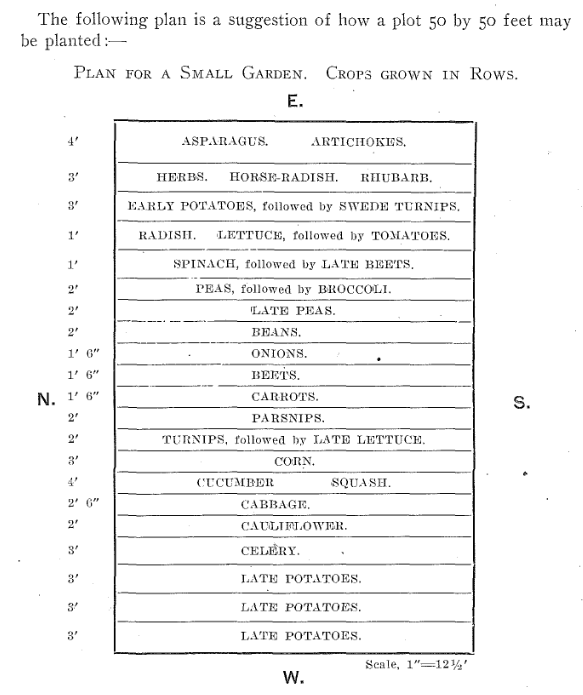
All you needed was a 50' X 50' plot of land dedicated to your garden... Another 50' X 100' for the house and stable.
![]() |
| Gardening on a City Lot in BC |
January and February, kale, parsnips, leeks, lettuce, and parsley;
March,spinach and broccoli;
April, radish, onions, rhubarb, and broccoli;
May, asparagus and peas;
June, early cabbage, carrots, and beets;
July, early potatoes, parsnips, and beans;
August, tomatoes, cauliflower, onions, cucumbers, and summer squash;
September, cabbage, salsify, and herbs;
October, celery, brussels sprouts, leeks, and winter squash;
November, fall lettuce and early spinach;
December, same as for January and February.
Besides the fresh vegetables which may be had through the winter months, the gardener can have a large variety stored, including potatoes, beets, carrots, onions, celery, squash, and turnips.
In 1921 the BC Government pegged the costs of food shopping at Thirty-Five cents a day One Hundred Twenty Seven and 75/100 Dollars per year.
2013, taking into account Inflation.... that works out to $1,536.76 ..... per year. Does that sound about right?
Or does it mean that the Bank of Canada Inflation bean counters software is out of whack, has been out of whack for a long time.
The early settlers but later than 1886, following the First World War, were encouraged to come to Canada, to British Columbia where they had to clear the trees, the stumps, plow the land, seed the fields, tend the fields, harvest the field, and have the resources, FOOD to last until the next year ..... like these Links to previous Posts here at the BBC.
Soldiers and Raspberries, Stalwart Peasant, Oats, Wheat and Barley Grows. Firsts for Women, Taxes and Tolls, Pigeon Phones, 125 year old Vancouver, Tom Carter Gallery, Len Norris, Warner Loat, Trutch
Were City Lots dimensions determined by the need of its residents to fend for themselves, wholly dependent upon the land? Were the backyard buildings still housing stables for horses, soon to be replaced by cars... which didn't create manure for the garden? Up until 1950's Dairyland delivered their milk by HORSE... the manure was fantastic.... so Mr. D (our neighbour) used to say.... D is for Davis....
Today's residential Front Yards, now they could be used for a vegetable garden..... 26' setback X 50' wide or 33' wide... as long as there are not Horse Chestnut Trees growing on the front street .... would the southern facing street front yards have more daylight than the their Northern facing front yards .... all depends on the size of the house, not by today's standards, but pre 1921.... is there an inflation counter for buildings...
A greenhouse would help....
Saturday, April 16, 2011
Vancouver 125 years old, brings back memories, captured in photos of old and new paintings today
One of the icons of Vancouver restaurant history, the Aristocratic stands open for business at the corner of Granville and Broadway (south west corner) on September 25, 1951. The eatery, now only a memory, was among several Aristocratics around the city.
Art Jones Photo, from the Vancouver Public Library special collections No. 81669I remember this intersection well, my family's home was two and half blocks away. One thing that is not mentioned in the Vancouver Sun on page H1, is that on the North East corner of Broadway and Granville there was another Aristocratic, a drive-in, somewhat like the WhiteSpot. Too bad we didn't have a Google Streetview back then.
At Fir (one block west of Granville) and Broadway was a baseball stadium (North East corner all the way to Eighth Avenue)(Vancouver Center Park). This was the predecessor to Little Mountain's Nat Bailey Stadium. Rumour has it that Nat Bailey sold his first hot dog at the stadium at Broadway and Fir.
Four doors to the south of the Aristocratic, shown in this morning's newspaper, was the Ingledew shoe store which had the latest technology to make sure that the shoe was the right fit for their customers, young and old.
From the photo below you can see that the X-Ray machine was a well thought out design, where the customer would be encouraged to lean against it so that he could see his own feet inside his yet to be purchased high-priced leather shoes. The saleman, lucky fellow, had the golden opportunity to see the same results, day in, day out, without lifting a fingers to test the distance of the customer's toe to the shoe's toe.
For some strange reason, the X-Ray machine was removed, should have been outlawed. Don't know whether it was the WAC Bennett Provincial government, the City of Vancouver Health Inspectors, or the shoe Industry at large that finally woke up to the fact of the harmful effects of X-Ray while seeing the results in REAL-TIME (fluoroscopy).
The radiation hazards associated with shoe fitting x-ray units were recognized as early as 1950. The machines were often out of adjustment and were constructed so radiation leaked into the surrounding area.
The Vancouver Public Library has all sorts of photographs of our most livable city in the world, but here's another source, a local artist, Tom Carter.
Tom continues to capture new ideas from the photographs that he has collected over many years, by bringing them back to life in his paintings, especially under the weather conditions that we all so adore here. Rainy, Saturday night where Theatre Row is lit up with neon lights.
The center painting below is the same Aristocratic's, at Broadway and Granville (South West corner), not sure if the photo to the left is inside the Aristocratic, but it looks just about right.
![]() |
| http://www.tomcartergallery.com/index.html |
"I love the urban environment - a fascinating cross sectionTom's painting are hanging at the Baron Gallery in Gastown:
of society where people in very different situations must
interact. Cities may also be where loneliness is felt more
acutely.
My art explores themes of isolation versus inclusion – how
we fit into the world and society. I tend to set my subjects
in other eras which, besides satisfying my historical interest,
reveals elements that are timeless – truths do not change.
Although there might be cold and turbulence in my work,
all of my settings have a sanctuary, a place of warmth and
respite. We, as the viewer, have the option of going inside
but we choose not to; we stand outside observing."
- Tom Carter
Intersections - paintings by Tom Carter
Wednesday to Saturday Noon till Six pm
Who else can remember this, the construction of the Granville Bridge? One of the finishing touches was that the city of Vancouver had a merry-go-round, and a ferris wheel too, for the opening ceremonies, in the area where the south bound bridge traffic would exit onto Fir Street and Fourth Avenue.